
SEO Guide
How Much Does a Website Redesign Cost? Honest 2026 Guide
July 16, 2026
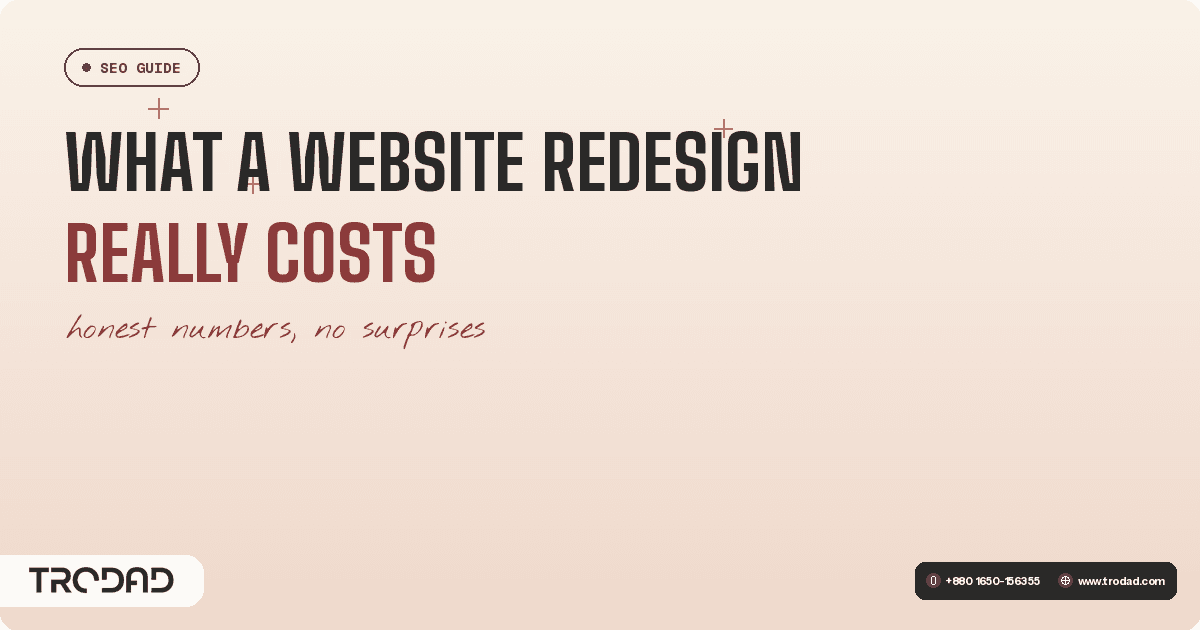
Ask five agencies how much a website redesign costs and you will get five numbers, sometimes an order of magnitude apart — and rarely a clear explanation of why. That is not because pricing is a dark art. It is because most agencies benefit from keeping it vague.
This guide does the opposite. We have launched 135+ websites since 2018 for clients across 10+ countries, and the cost drivers are the same everywhere. Here is what actually determines the price of a redesign, realistic ranges by project type, and the places where quotes get quietly padded — so you can read any proposal, including ours, with clear eyes.
What actually drives redesign cost
Every honest redesign quote is built from the same five ingredients. When a number seems high or low, one of these is the reason.
1. Scope: how much is really being redone
"Redesign" covers everything from a visual refresh on existing structure to a full rebuild with new information architecture, new content, and a new platform. A refresh reuses your foundations; a rebuild replaces them. The difference in effort — and cost — is typically 2–4x. Be precise about which one you are buying, because agencies quoting wildly different numbers are often quoting different projects.
2. Page count and template count
What matters is not the raw number of pages but the number of unique layouts. A 40-page site built from 6 well-designed templates costs far less than a 15-page site where every page is bespoke. When you brief agencies, list your page types — home, service, about, contact, blog, case study — rather than just a page total. You will get sharper quotes.
3. CMS and platform decisions
Staying on your current platform is cheaper than migrating. Moving to a new CMS adds content migration, redirect mapping, and retraining — real work that belongs in the quote. It is often worth it: a platform your team can actually use pays for itself in every update you no longer email a developer about. But it should be a line item you can see, not a silent multiplier.
4. Custom features and integrations
Booking systems, customer portals, calculators, CRM integrations, multilingual support, e-commerce — each is a mini-project inside the redesign. This is the single biggest source of quote variance. Two "10-page business sites" can differ by thousands purely on features. List every integration you need up front; features discovered mid-project are always more expensive than features scoped on day one.
5. Content: who writes and supplies it
The most commonly forgotten cost. If the agency is writing your copy, sourcing imagery, and structuring your case studies, that is real strategic work and it will show in the price. If you are supplying finished content, say so — it should visibly reduce the quote. Sites stall in production more often over missing content than over anything technical, so decide this before signing, not after.
Typical price ranges by project type
With those drivers in mind, here are realistic 2026 market ranges. Every market has outliers in both directions, but if a quote lands far outside these bands, ask why — there may be a good reason, and you deserve to hear it.
- Visual refresh (template-based, existing structure and content): roughly $1,000–$5,000. New skin, same skeleton. Right choice when your structure works but the look is dated.
- Standard business site redesign (custom design, 5–15 page types, CMS): roughly $5,000–$15,000. The most common bracket for established small and mid-sized businesses.
- Redesign with e-commerce or custom features: roughly $10,000–$30,000. The store, portal, or integration layer is where the additional budget goes.
- Large or complex rebuilds (replatforming, many templates, heavy integrations): $30,000 and up. At this level you are buying architecture and strategy, not just design.
One honest caveat: cheap and expensive both exist for a reason. A $500 redesign is usually a template with your logo dropped in — fine until you hit its ceiling, which is sign number one that you will be paying again soon. An inflated quote, meanwhile, often funds agency overhead rather than your project. The question is never "what is the lowest number" but "what does this number buy, and can I verify it."
Where agencies pad costs — and how transparency fixes it
Most padded quotes are not fraud; they are fog. Cost hides where visibility ends. The classic spots:
- Vague line items: "Discovery & strategy — $4,000" with no deliverable attached. Strategy is valuable; a strategy line with no output is padding. Ask what document, sitemap, or prototype you receive for it.
- Project management layers: when you talk to an account manager who talks to a producer who talks to the designer, you are paying every link in that chain. Ask who you will actually communicate with during the project.
- Revision anxiety pricing: agencies that expect messy feedback loops price the chaos in. Clear process is cheaper for everyone — which is why at TRODAD revisions are welcome until you are fully satisfied, stated up front rather than metered out.
- Hostage fees: the padding you discover last — charges to hand over your own files, or hosting lock-ins that make leaving expensive. You should get instant access to all design and source files on approval. If a contract doesn't say so, that silence is a price you will pay later.
Our answer to the fog is structural, not rhetorical: clients order online at a stated price, then track every stage in a client portal — progress, chat with the team, billing, all in one place. You can see exactly how that flow works on our work process page. When the client can see everything, there is nowhere for padding to hide. Design delivery runs 48–100 hours, and payment options are published, not negotiated in the dark.
How to budget for your redesign
A practical sequence that keeps you in control:
- Separate must-haves from nice-to-haves. Speed, mobile, clear conversion paths, and an editable CMS are must-haves. The animated homepage hero is not. Budget for the first list; phase the second.
- Write a one-page brief. Page types, features, integrations, who supplies content, and what "success" means in numbers. This document does more to control cost than any negotiation tactic.
- Get quotes on identical scope. Comparing quotes on different scopes is how owners end up choosing the vaguest bidder. Same brief to every agency, then compare like with like.
- Confirm ownership and process in writing. Source files on approval, named point of contact, and visible progress tracking. These clauses cost nothing and prevent the expensive surprises.
- Hold back budget for after launch. A redesign is not the finish line. Reserve something for maintenance and iteration — the sites that keep winning are the ones that keep improving. Our website redesign service is scoped so you know exactly what launch includes and what comes after.
FAQ
Why do redesign quotes vary so much between agencies?
Usually because the agencies are quoting different projects. Without a precise brief, one assumes a refresh, another assumes a rebuild, and a third pads for uncertainty. Fix the brief and the spread narrows dramatically.
Is a website redesign worth the cost?
If your current site is slow, weak on mobile, or visibly dated, yes — those problems suppress conversions on every visit, and that suppression compounds monthly. A redesign is one of the few marketing investments that keeps paying on every future visitor without ongoing spend.
Can I redesign my website in phases to spread the cost?
Often, yes. A sensible phasing puts structure, speed, and key landing pages first, then rolls out secondary pages and nice-to-have features. Phasing works when it follows a plan; it fails when it is improvised, so agree the full roadmap before phase one begins.
What should a redesign quote always include?
Named deliverables per line item, page/template counts, listed features and integrations, who supplies content, revision terms, a timeline, and explicit confirmation that you receive all source files. If any of those is missing, ask — the answer tells you a lot about the agency.
Book a free consultation — let's talk about your project. trodad.com/appointment
Share:
Newsletter
Enter your email address below to subscribe to my newsletter
LOCATION
USA
Lenox Hill, Manhattan,
New York
BANGLADESH
House - 761, Road - 10, Avenue - 6, Mirpur DOHS, Dhaka - 1216, Bangladesh
LOCATION
USA
Lenox Hill, Manhattan,
New York
BANGLADESH
House - 761, Road - 10, Avenue - 6, Mirpur DOHS, Dhaka - 1216, Bangladesh
©2018-2026 All Rights Reserved. TRODAD is a registered trademark of TRODAD International LTD. Apple and the Apple logo are trademarks of Apple Inc. Google Play and the Google Play logo are trademarks of Google Inc. Privacy | Terms | Security | Cookie Preferences